
Table of Contents:
- Introduction
- Georgia ADUs Experience from the National Zoning Atlas and Abundant Housing Panelists
- How to Navigate Gwinnett County’s Municipal Code Structure
- How to Navigate DeKalb County’s Municipal Code Structure
- How to Navigate City of Atlanta’s Municipal Code Structure
- Which Municipality is the Least Restrictive and Most ADU-Friendly?
- So Which Zones Allow ADUs?
Introduction
At Georgia ADU, we are proud to call ourselves your local zoning experts. We are the professionals you can trust to handle all of the permitting, site planning, architectural designing, passing inspections, and getting your new Accessory Dwelling Unit (ADU) stick-built and functioning without a hitch.
The first thing we offer to all of our potential clients – for a smooth FREE-99 – is our over-the-phone free consultation, which you can book by filling out the form on our website. By assisting every lead that comes our way, we’ve become experts in the niche speciality of Atlanta municipal code. We’ve done the work and built the rapport within and around the City of Atlanta – so you don’t have to lift a finger to call any legislators, or peer down the pages of any city code, or make any begrudgeoned visits to any bureaus. Just give us a call at Georgia ADU, and we will take care of the rest for you and your family.
Georgia ADU is a team of 20+ tradespeople with operations being led by qualified, communicative, and transparent teams. The three lead members on our team share a combined 80+ years of experience in residential construction in and around Atlanta.
We’ve handled thousands of leads which has garnered us experience with 21+ Metro-Atlanta municipalities, and counting! Whether you live Inside the Perimeter (ITP) or Outside the Perimeter (OTP), we’re positive that homeowners and investors like you most likely live within one of three of the most ADU-friendly municipalities we build in: City of Atlanta, DeKalb County, or Gwinnett County.
Cobb County deserves its own blog post, and we’ll save that letterhead for another day. We receive a great deal of inquiries from Cobb property owners – and by all means, keep ‘em coming! – but we have to hoist the disclaimer pretty promptly: Cobb County is not friendly to detached ADUs and does not currently offer legislation which permits guest houses. Rather, Cobb County only permits additions, or what some might deem an attached dwelling unit with an enclosed, heated and cooled hallway no more than 25 feet connecting it to the primary residence.
So, without further adieu, in this blog post, we will guide you through exactly how to decipher lengthy code and locate pertinent ADU info within Gwinnett County’s Municipal Code, DeKalb County’s Municipal Code, and the City of Atlanta’s Municipal Code.
Bonus: If you stick with us and read through the end, we’ve got a treat for you! We’ll summarize exactly which zones are ADU approved per each municipality!
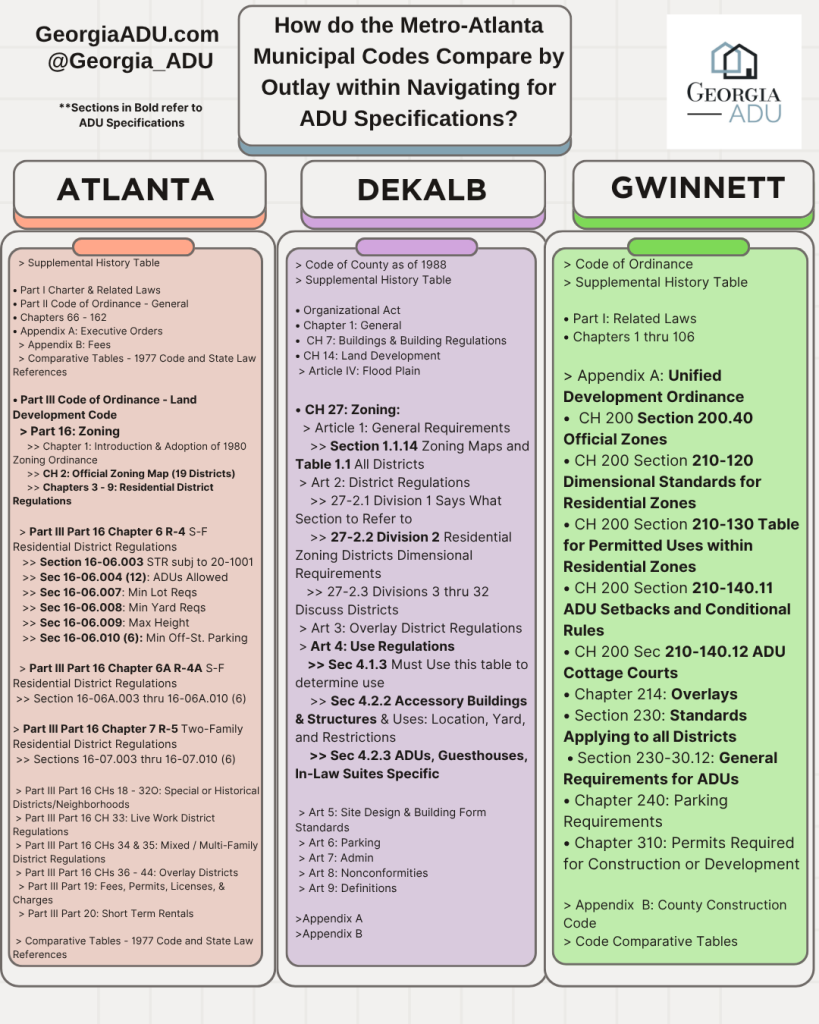
Image 1. This outline offers a comparative view of the way or formatting of the municipal codes from City of Atlanta, Dekalb County, and Gwinnett County. Atlanta’s code is formatted into Parts, Appendices, Parts within Parts, and then Chapters and Sections. DeKalb County’s code is formatted into Chapters, Articles, Sections, then Appendices. Gwinnett County’s code is formatted into Parts, Chapters, and then Appendices, where Appendix A has been specifically set aside and designated for its functional UDO which is formatted into Chapters and Sections only. Currently, the City of Atlanta has paid some consultants to re-write this current code from 1980, and has been nicknamed Atlanta Zoning 2.0. City Council has allowed public comment in early 2026, and is now viewing Zoning 2.0 in the revision and adoption stages. Dekalb’s code is old, but not that old. Gwinnett’s code is new, and was recently revised in Spring of 2026. Gwinnett could be viewed as the most progressive of the three due to its adoption of a UDO (a Unified Development Ordinance) which is pro-ADU / ADU-friendly and provides more-direct instructions on how to navigate building an ADU by including a conditional use table for residential zones, a dimensional standards table, a setbacks table, an A through L bullet list for rules specifically for ADUs, and a new amendment allowing ADU Cottage Courts aka ADU communities. Atlanta’s code is the most convoluted and redundant due to not being revised for 40 years, but it is less micro-managing than Dekalb County’s code. Dekalb County has rules for almost every accessory structure under the sun. Gwinnett’s code seems to be the happy medium between what Atlanta is trying to bridge the gap for and what Dekalb over-extends for.
Georgia ADUs Experience and Education from the National Zoning Atlas and Abundant Housing Panelists
Recently, we at Georgia ADU, attended the National Zoning Atlas’ seminar at the Auburn Avenue Research Library, co-hosted by Abundant Housing on December 8, 2025. At this seminar, we learned about how municipalities can be “graded” by the length of pages and number of lines of their Codes. So we analyzed these three codes, and pulled together a visual comparison for you below:
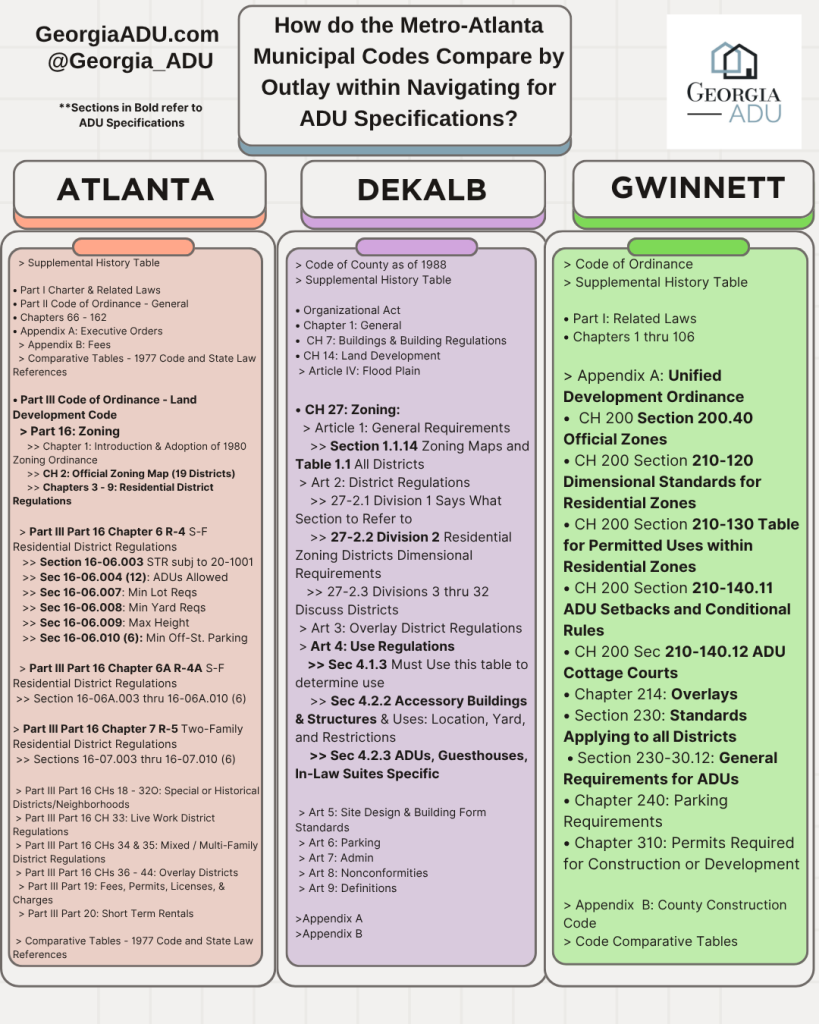
As you can see here, it’s complicated! Every municipality has a different way of approaching, outlining, and articulating their own Code. When you get into how a municipality writes their Specifications on ADUs, that’s a whole new story in itself! In fact, some municipalities don’t write ADU regulations at all! Some municipalities aren’t hip to the ADU housing solution movement, some municipalities outright prohibit ADUs, some municipalities adopt Unified Development Ordinances (UDOs) to address ADUs, other municipalities write their own ADU sections, and some municipalities go zone by zone to write-in ADU rules.
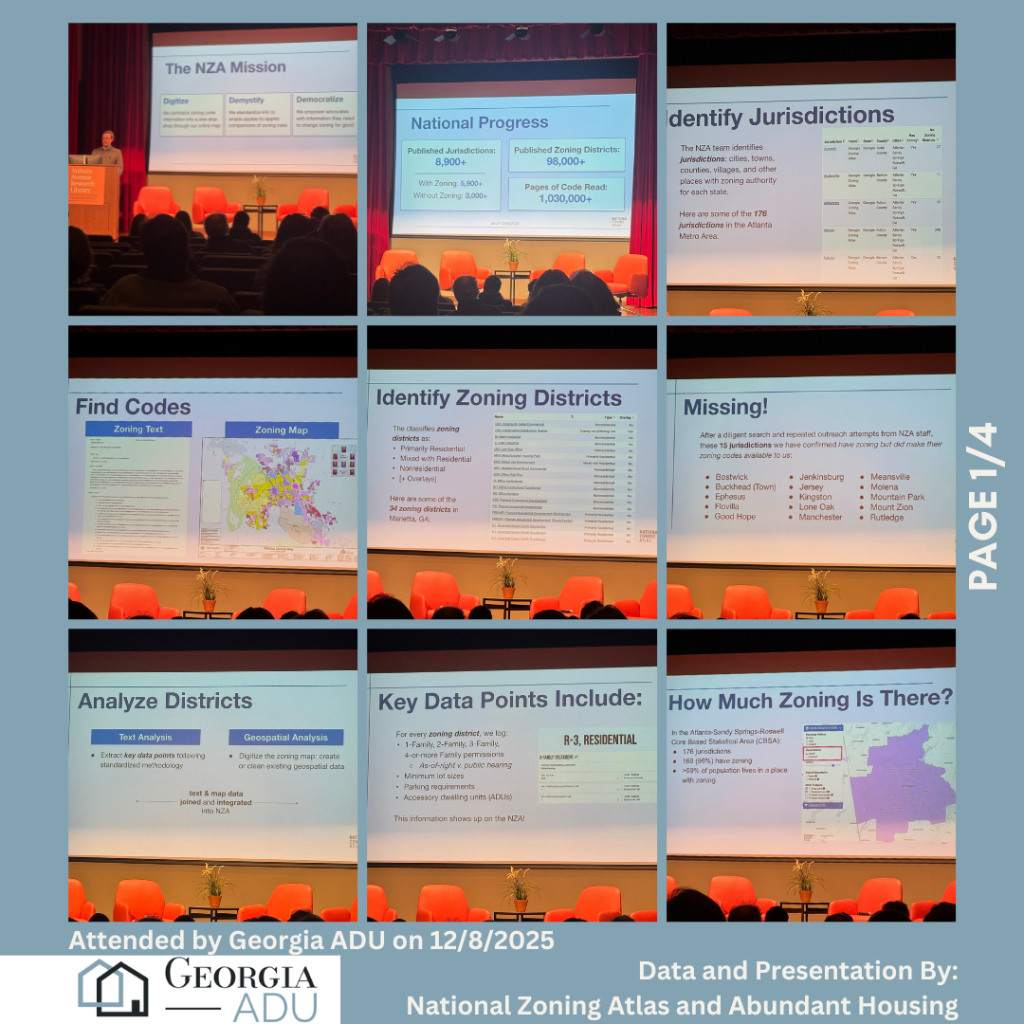
The state of Georgia does not require municipalities to have uniformity, and that’s okay. That’s what local legislators are all about – culture and character! During the National Zoning Atlas’ seminar, we also learned that we need more citizens to be aware of the legislative possibilities in order to get boots on the ground and spread the word-of-mouth to constituents like you.
A mass surge of constituents vocalizing to their locally-elected officials that you want positive change and permissibility for ADUs is the only way to improve the situation for all Municipal Codes. . Improved local legislation is the only way to ensure that Georgians like you have access to the same investment opportunities and wealth strategies as the Joe down the road. We might be biased, but ADU’s are a pretty awesome housing strategy (read more about why in our blog: 11 Benefits of Building an ADU.)
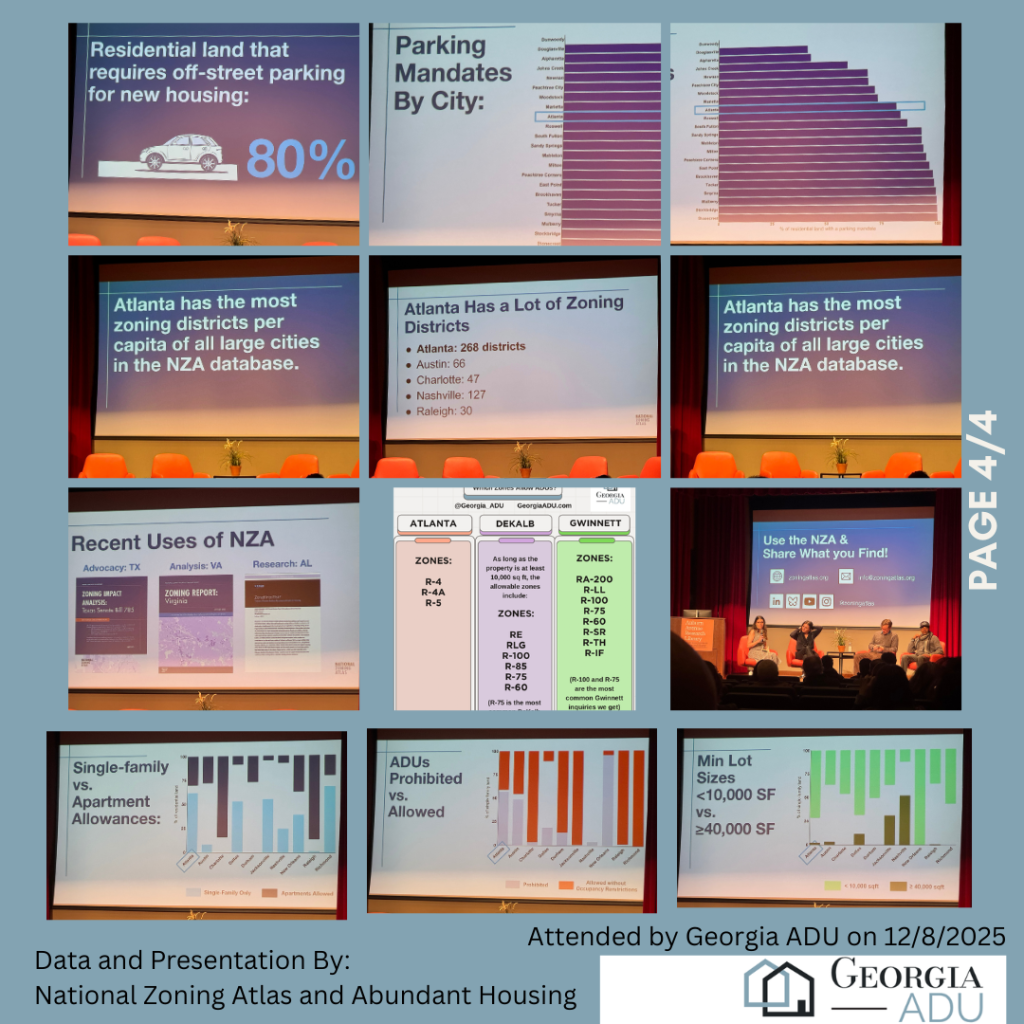
The National Zoning Atlas attested they have surveyed the entire nation and built an interactive database. Their research abets them in asserting that municipalities like Durham, NC and Charlotte, NC have some of the most forward-friendly-for-ADUs legislation in the country. One panelist also advised that Atlanta should adopt the right to sub-divide parcels in order to gain funding for the sub-divided area containing the would-be-ADU. He said Durham long ago adopted this legislation, as well as many more regulations that promote, provide, and budget for citizen funding options to build ADUs.
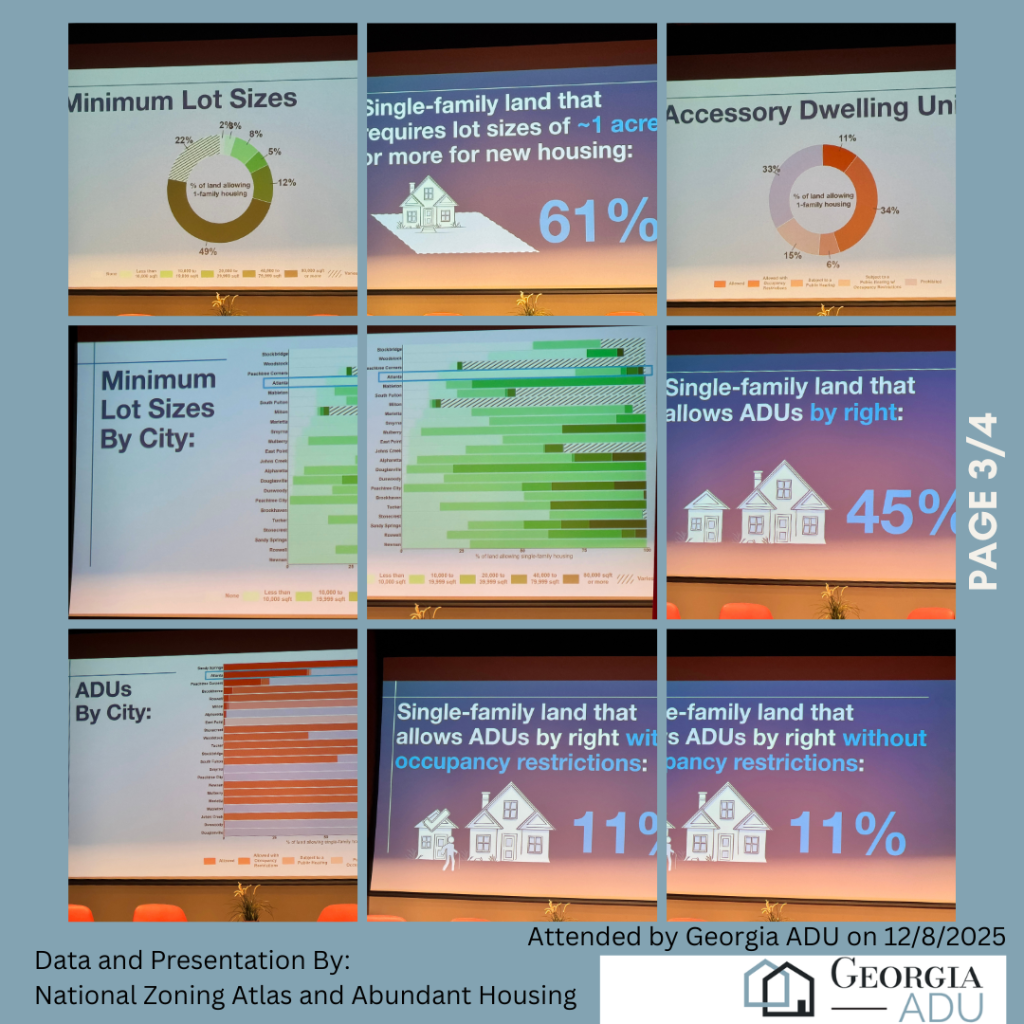
Now that we’ve illustrated the need for community unison, legible (not lengthy) legislation, and feasible regulations, let’s go over how to navigate each municipality’s code structure.
How to Navigate Gwinnett County’s Municipal Code Structure to Decipher ADU Specifications for ADU-Approved Zones
In Gwinnett County, the local legislators have adopted the UDO, or Unified Development Ordinance, which codifies for all residential zones – except RA-200 – the regulations each zone must follow for erecting Accessory Dwelling Units (ADUs). This means that all residential zones in Gwinnett, except RA-200, can build an ADU so long as they follow the rules outlined in the UDO. The UDO also mandates that each permit submission must include a detailed Accessory Building Location Plan.
Because Gwinnett County is vast with smaller towns, upon individual inquiry we sometimes go directly to the specific town’s municipal code, depending on the GIS (Geographic Information System) results.
The important takeaways of the Gwinnett County UDO – besides the obvious, common sense notches – are this:
Verbiage and Jargon: Accessory structures include detached garages, sheds, pools, tennis courts, trampolines, gazebos, utility buildings, barns, and (you guessed it) ADUs
The accessory structure cannot be in the way of a right-away (think “driveway/navigation/cul-de-sac”)
Has to be subordinate and supportive to the Primary Dwelling Unit (PDU); must be secondary and the baby must look like the parent
Must be in the rear yard ONLY
IF this is corner lot property – which has 2 front yards by default – the accessory structure is NOT allowed in the side yard of a corner lot that faces a public street
Setbacks are based on structure size versus area of property:
- 0 – 100 square feet = 5 feet set-back
- 101 – 300 square feet = 10 foot set-back
- 301 – 500 square feet = 15 foot setback
- 500+ square feet = 20 foot set-back
In all residential zoning districts, except RA-200:
The area of accessory structures allowed is cumulative and based on lot size (i.e. your property may be zoned R100 because it is under 10,000 square feet, and because of its lot size it may only be allowed to have a 40% accessory coverage; so it can have two accessory structures like a shed and a pool, but the combined area cannot exceed 40% of the lot or a total sum of 4000 sq ft).
The accessory structure cannot exceed 50% of the PDU. This represents the Floor Area Ratio (FAR), 50% = 0.5).
(i.e. your main house is 1300 sq ft. .5 of 1300 is 650 sq ft. This means your accessory structure must have a floor area of 650 sq ft or less).
The accessory structure cannot be used for any human inhabitation, except for accessory dwelling (DING DING DING! THAT’S US!)
You cannot use the accessory structure to store any hazardous waste material
Now moving on, the next step in determining if you can build an ADU in Gwinnett County is referring to the specific municipal code for your property’s Zoning (not to be confused with Zone Class), which you can determine from the GIS or tax assessor data. You always want to ensure you’re reading an updated version of the code. Some ordinances publish PDFs, and those files can stay up for years at a time as an outdated relic. That’s why you can trust Georgia ADU: we know how to verify the credibility and trustworthiness of our resources.
In the municipal code, there is a Section 14 for Buildings with portions of 14.1 – 14.56 deferred by a “Reserved” title. The resident should then scroll to the Appendix A and find the UDO starting at Chapter 200 of the Code. Section 200.40 of the Code distinguishes the official Zones of Gwinnett County, and Section 200.40.2 describes the now inactive zones. Chapter (or Section) 210 goes on to define each of the Zones based on characteristics.
Section 210-130 lists the allowable uses for each Zone, and this is where we find a “C” for “conditional use” for Accessory Dwelling for the following Zones:
These are the residential zones that allow ADUs per Gwinnett County:
- RA-200 = Agriculture-Residence District
- R-LL = Single-Family Residence-Large Lot District
- R-100 = Single-Family Residence District
- R-75 = Single-Family Residence District
- R-60 = Single-Family Residence District
- R-SR = Senior Oriented Residence District
- R-TH = Single-Family Residence Townhouse District
- R-IF = Residential In-Fill District
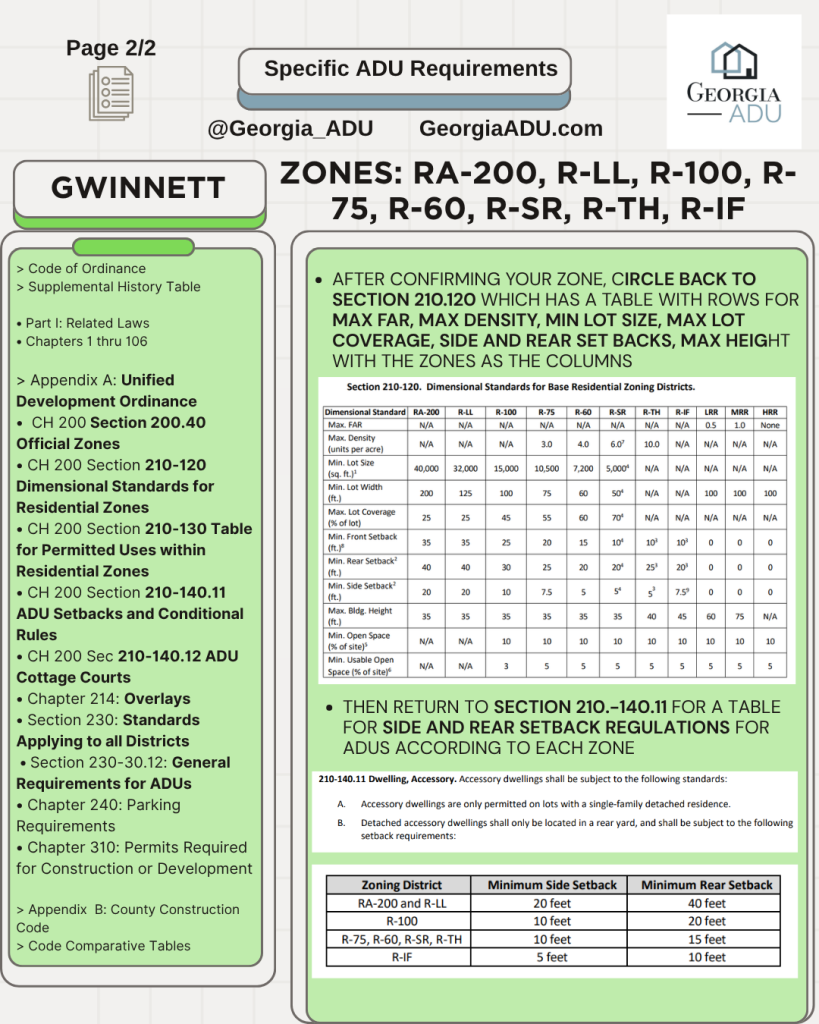
“C” for “Conditional Use” means that each of these Gwinnett County Zones are subject to Section 210-120 which gives the following allowable limits and regulations:
Section 210-120. – Dimensional Standards for Base Residential Zoning Districts.
| RA-200 | R-LL | R-100 | R-75 | R-60 | R-SR | R-TH | R-IF | LRR | MRR | HRR | |
| Max. FAR | N/A | N/A | N/A | N/A | N/A | N/A 4 | N/A | N/A | 0.5 | 1.0 | None |
| Max. Density (units per acre) | N/A | N/A | N/A | 3.0 | 4.0 | 6.0 6 | 10.0 | N/A | N/A | N/A | N/A |
| Min. Lot Size (sq. ft.) 1 | 40,000 | 32,000 | 15,000 | 10,500 | 7,200 | 5,000 4 | N/A | N/A | N/A | N/A | N/A |
| Min. Lot Width (ft.) | 200 | 125 | 100 | 75 | 60 | 50 4 | N/A | N/A | 100 | 100 | 100 |
| Max. Coverage (% of lot) | 25 | 25 | 45 | 55 | 60 | 70 4 | N/A | N/A | N/A | N/A | N/A |
| Min. Front Yard (ft.) 2 | 35 | 35 | 25 | 20 | 15 | 10 4 | 10 3 | 10 | 0 | 0 | 0 |
| Min. Rear Yard (ft.) | 40 | 40 | 30 | 25 | 20 | 20 4 | 25 3 | 20 | 0 | 0 | 0 |
| Min. Side Yard (ft.) | 20 | 20 | 10 | 7.5 | 5 | 5 4 | 5 3 | 7.5 | 0 | 0 | 0 |
| Max. Bldg. Height (ft.) | 35 | 35 | 35 | 35 | 35 | 35 | 40 | 45 | 60 | 75 | N/A |
| Min. Project Area (acres) | N/A | N/A | N/A | N/A | N/A | 10 | 2 | N/A | N/A | N/A | N/A |
| Min. Open Space (% of area) 5 | N/A | N/A | 10 | 10 | 10 | 10 | 10 | 10 | 10 | 10 | 10 |
- Larger minimum lot sizes may be required for lots served by septic.
- Where the backs or sides of single-family attached or detached residential units are oriented toward an external public street, a 40-foot-wide setback with a 10-foot-wide landscape strip adjacent to the right-of-way shall be required between the property line and residential units.
- External property line setbacks.
- For detached lots only. Attached villas are subject to the conditional use requirements of this Chapter.
- Does not apply to individual lots within single-family detached residential zoning districts.
- For attached villas only. The maximum density for detached lots shall be 4.0.
Note: a Single Family Detached Dwelling, which is denoted with a “P” for “Permitted,” refers to your PDU. Your PDU is a detached dwelling on a single family residential lot.
The code then goes on to specify the setback regulations for ADUs in Gwinnett County in Section 210-140.10:
| Zoning District | Side Yard Setback | Rear Yard Setback |
| RA-200 and R-LL | 20 feet | 40 feet |
| R-100 | 10 feet | 20 feet |
| R-75, R-60, R-SR, TND | 10 feet | 15 feet |
| R-IF | 5 feet | 10 feet |
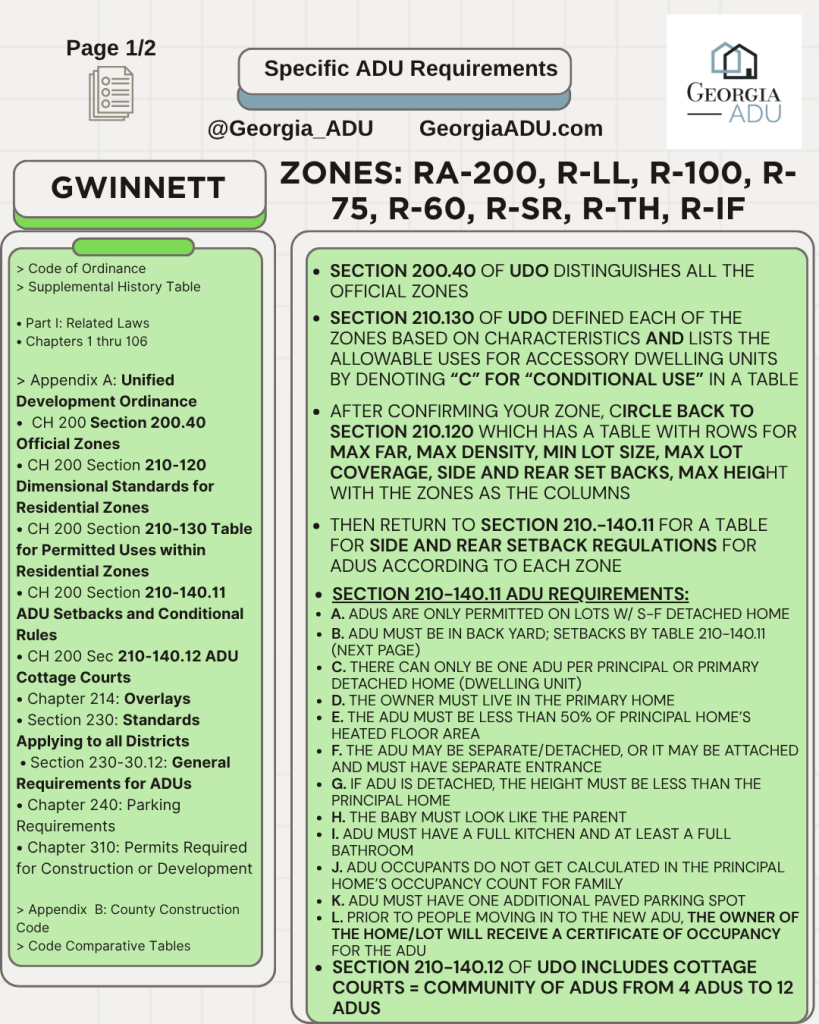
This section, Section 210-140.11, includes several rules. Aside from the common sense rules, the main rules to pay attention to are:
- A. ADUs are only permitted on lots with single-family detached home
- B. ADU must be in back yard; Setbacks by Table 210-140.11
- C. There can only be one ADU per principal or primary detached home (dwelling unit)
- D. The owner must live in the primary home
- E. The ADU must be less than 50% of principal home’s heated floor area
- F. The ADU may be separate/detached, or it may be attached and must have separate entrance
- G. If ADU is detached, the height must be less than the principal home’s height
- H. The baby must look like the parent
- I. ADU must have a full kitchen and at least one full bathroom
- J. ADU occupants do not get calculated in the principal home’s occupancy count for family
- K. ADU must have one additional paved parking spot (plus what the original/primary home is required to have)
- L. Prior to people moving in to the new ADU, the owner of the home/lot must receive a Certificate of occupancy for the ADU
For real estate investors, Gwinnett County has updated its code to include Section 210-140.12 for Cottage Court Dwelling Units – for a community of ADUs ranging from as little as 4 ADUs to 12 ADUs
Notable Sections in Gwinnett County Municipal Code UDO regarding ADUs include:
- Chapter 214: Overlays
- Section 230-10 – 230-30.12: General Requirements – ADUs Specifically
- Chapter 240: Parking Requirements
- Chapter 310: Permits Required for Construction or Development
How to Navigate DeKalb County’s Municipal Code Structure to Decipher ADU Specifications for ADU-Approved Zones
DeKalb County is a peculiar place. It is Atlanta, but it’s Decatur too! What an interesting predicament!
In the beginning of the code, you will find chapters indicating Building Regulations and Land Development (Chapters 7 and 14), but you actually want to skip all that in the beginning. These sections mostly just describe how DeKalb intends these committees to function.
What you really are looking for is Chapter 27: Zoning.
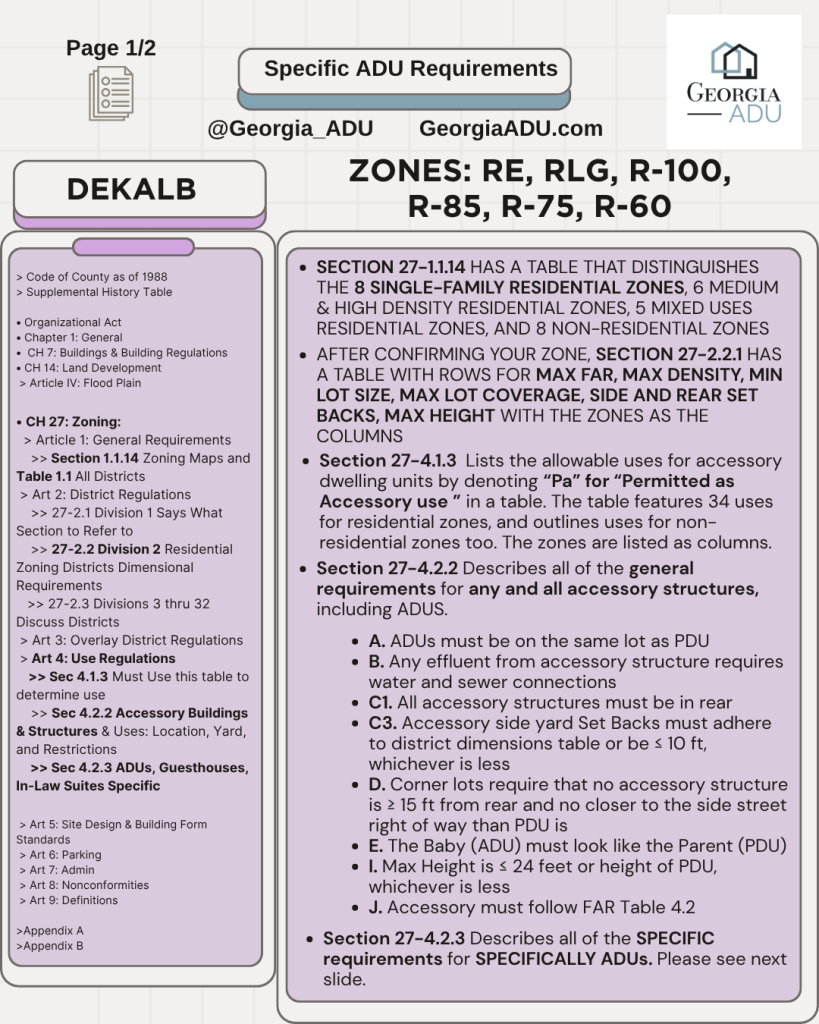
Chapter 27: Zoning is where all the juicy details about the districts and what is and isn’t allowed is located. In the first Article (General Requirements), the zoning districts are described by former name, type, and new name. This can be found in Section 1.1.14 and Table 1.1. There are 8 Single-Family Districts in Dekalb (this is important for later!). The 8 Single-Family (S-F) Districts include RE, RLG, R-100, R-85, R-75, R-60, MHP, and RNC. In addition to these, there are 6 Medium & High Density Residential Districts (RSM, MR-1, MR-2, HR-1, HR-2, and HR-3); there are 5 Mixed Use Residential Districts (MU-1, MU-2, MU-3, MU-4, and MU-5); and there are 8 Non-Residential Districts (NS, C-1, C-2, M, M-2, OIT, and OD).
The next important section in the code is Chapter 27-2.2 Division 2 Section 2.2.1. The Residential Zoning Districts Dimensional Requirements specifically describes the lot and primary residence requirements, but the DeKalb County Code expects builders, homeowners, and investors to adhere to this section when building an ADU. Heads up, DeKalb really enjoys implementing lengthy and complex, wide-mouthed tables! The table in this chapter describes columns as each of the regulated residential districts, and features important rows to take note of: minimum lot size (area), maximum allowable lot coverage, side setback, side setback for corner lots, rear setback, and maximum allowable height. It is important to note that the ADU must follow all the same rules the PDU will follow in this section. The remainder of Chapter 27 outlines each of the 27 DeKalb County districts.
Once you’ve combed over that section (Section 2.2.1 and Table 2.2), you’ve practically reached the center of the tootsie pop! Beyond Chapter 27 of Article 2 awaits Article 4! This is the Article you’ve been waiting for!
DeKalb County opted to keep their regulations for districts intact, implement multiple complex descriptive criteria tables, and incorporate their very own Article 4, Use Regulations, addressing ADUs specifically. This section includes three distinct sections that shape how homeowners and builders can build ADUs in the respective zones. The first important section here is Section 4.1.3, which includes (surprise!) another complex table, Table 4.1, the Use Table!
Please keep in mind when viewing the Use Table, zoning laws originally intended to determine which zones could have single-family homes (dwelling units) versus two-family or multi-family homes (also dwelling units). Therefore, when you read “single-family detached dwelling unit” in a code, this is usually referring to the Primary Dwelling Unit (PDU) – NOT an ADU. Additionally, a “single-family attached dwelling unit” would usually refer to an addition or garage conversion. ADUs are typically referred to as a type of accessory structure. That being said, DeKalb has included a row specifically for “Dwelling, Single-Family, accessory, (guest house, in-law suite)” so that you can’t mistake the permitted uses. This row of Table 4.1 features “Pa” indicating “Permitted as an accessory use” for 7 of the 8 Single-Family Residential Districts: RE, RLG, R-100, R-85, R-75, R-60, and RSM. Technically, Dekalb also gives permission as an accessory use for this section to all 5 Mixed Use Districts as well.
Finally, Section 4.2.2 of Article 4 outlines the general requirements for all accessory uses (including barns, fences, basketball courts, pools, etc.), and Section 4.2.3 gets down to the nitty gritty and outlines the mandated requirements for ADUs, Guest houses, and In-Law Suites. When building an ADU in Dekalb, BOTH of these sections must be satisfied AND it must be according to the permissibility outlined in Table 4.1.
Per Section 4.2.2, some of the most critical mandates include, but are not limited to:
- Accessory structure must be on the same lot as the PDU
- Any effluent from accessory structure requires water and sewer connections
- All accessory structures must be in the rear
- Accessory side yard setbacks (SBs) must adhere to the district dimensions table or be ≥ 10 ft, whichever is less
- Corner Lots require that no accessory is ≤ 15’ from rear and no closer to side street right of way than the PDU is
- The baby (ADU) must look like (exterior) the parent (PDU)
- Unless otherwise stated, the accessory structure must be ≤ 24’ or Height of PDU, whichever is less
- The Accessory structure must follow the FAR Table 4.2:
Table 4.2. Maximum Accessory Building Floor Area – Select Residential Structures
| Maximum Accessory Building Floor Area | |
| Property Size | Maximum Floor Area |
| 0 to 0.999 acres | 900 square feet |
| 1 to 4.999 acres | 1,200 square feet |
| 5 to 9.999 acres | 2,000 square feet |
| 10 or more acres | No size limit |
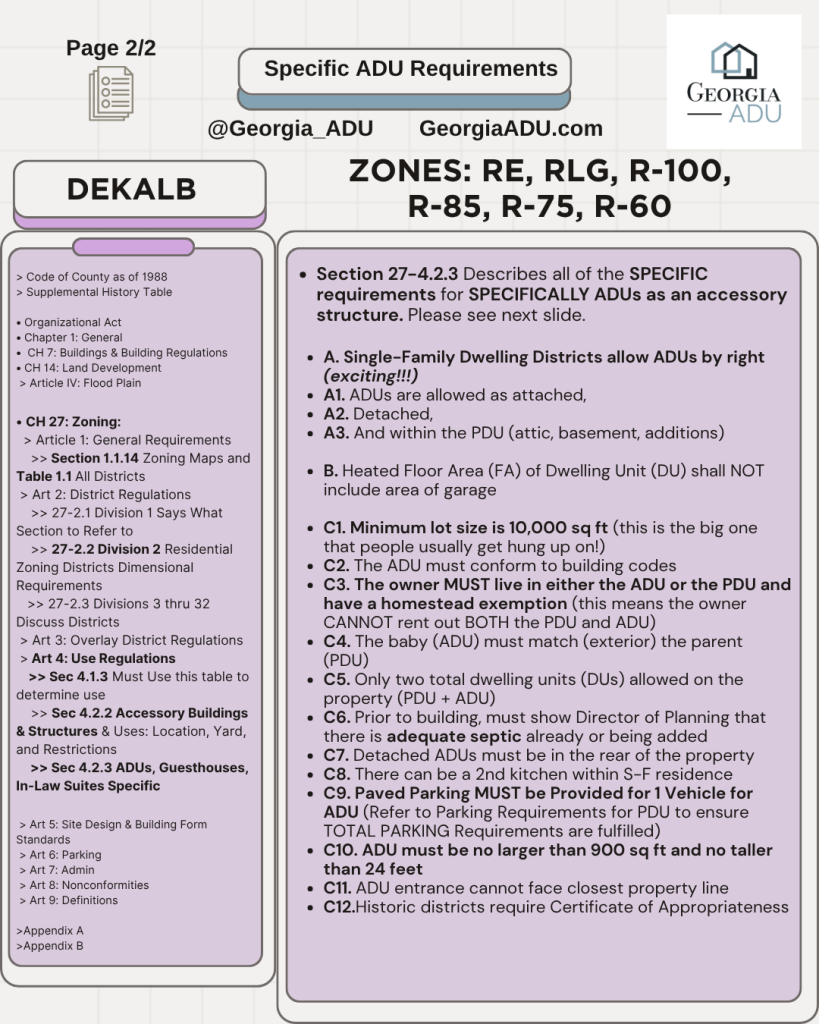
And per the ADU specific section, 4.2.3, the most important mandates include:
- Single-Family Dwelling Districts allow ADUs by right (exciting!!!)
- ADUs are allowed as attached,
- Detached,
- And within the PDU (attic, basement, additions)
- Heated Floor Area (FA) of Dwelling Unit (DU) shall NOT include area of garage
- Minimum lot size is 10,000 sq ft (this is the big one that people usually get hung up on!)
- The ADU must conform to building codes
- The owner MUST live in either the ADU or the PDU and have a homestead exemption (this means the owner CANNOT rent out BOTH the PDU and ADU)
- The baby (ADU) must match (exterior) the parent (PDU)
- Only two total dwelling units (DUs) allowed on the property (PDU + ADU)
- Prior to building, must show Director of Planning that there is adequate septic already or being added
- Detached ADUs must be in the rear of the property
- There can be a 2nd kitchen within S-F residence
- Paved Parking MUST be Provided for 1 Vehicle for ADU (Refer to Parking Requirements for PDU to ensure TOTAL PARKING Requirements are fulfilled)
- ADU must be no larger than 900 sq ft and no taller than 24 feet
- ADU entrance cannot face closest property line
- Historic districts require Certificate of Appropriateness
How to Navigate City of Atlanta’s Municipal Code Structure to Decipher ADU Specifications for ADU-Approved Zones
The City of Atlanta is unique in that the zoning lines have been split definitively to include some portions of DeKalb County and a large chunk of Fulton County. Atlanta stretches north into Vinings, Buckhead, Sandy Springs, Dunwoody, and Brookhaven, and reaches Northeast just beyond Briarcliff and Chamblee to touch Doraville; the city claims Outkast’s homage of East Atlanta and Decatur; the southern most part of the city hails Gresham Park and Lakewood from the East, College Park and Hapeville near the airport, and East Point from the SW. Just before the 285 perimeter cuts the city off and I-20 takes you into Mableton or Austell, Atlanta hosts the honorable Greenbriar community just off Camp Creek Parkway and connects to Cascade and the historical West End and Oakland City.
Atlanta certainly boasts a rich spectrum of historical and characteristically charming neighborhoods – many of which are notorious to the corners of the globe due to the influence of music icons like Outkast, Migos, and the Chariot, as well as world-reknown Coca-Cola, in addition to films like that of Driving Miss Daisy, The Hunger Games, Black Panther, and shows like The Walking Dead and Stranger Things. From fashion and film to innovation and technology, Atlanta represents a cultural, global, steadfast hub and truly does Influence Everything around us.
At Georgia ADU, we’re proud to call Atlanta home, and even prouder to serve families like yours. There’s no time like the present to build generational wealth through the investment of an ADU that lasts lifetimes to come!
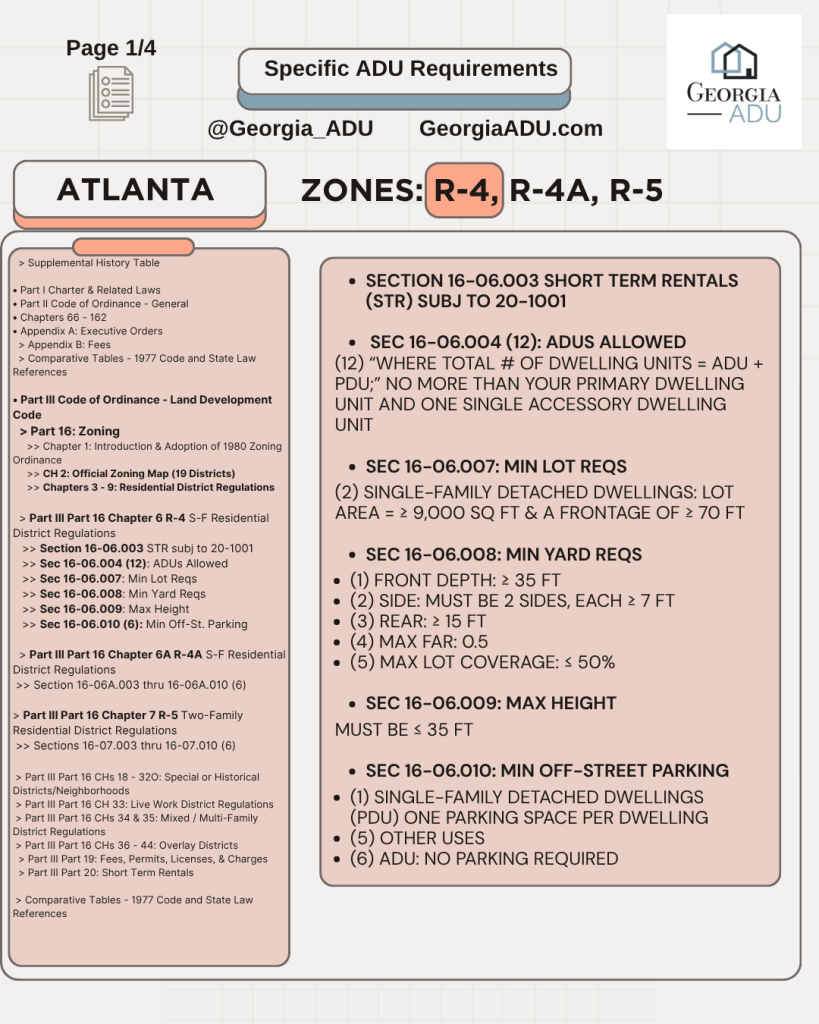
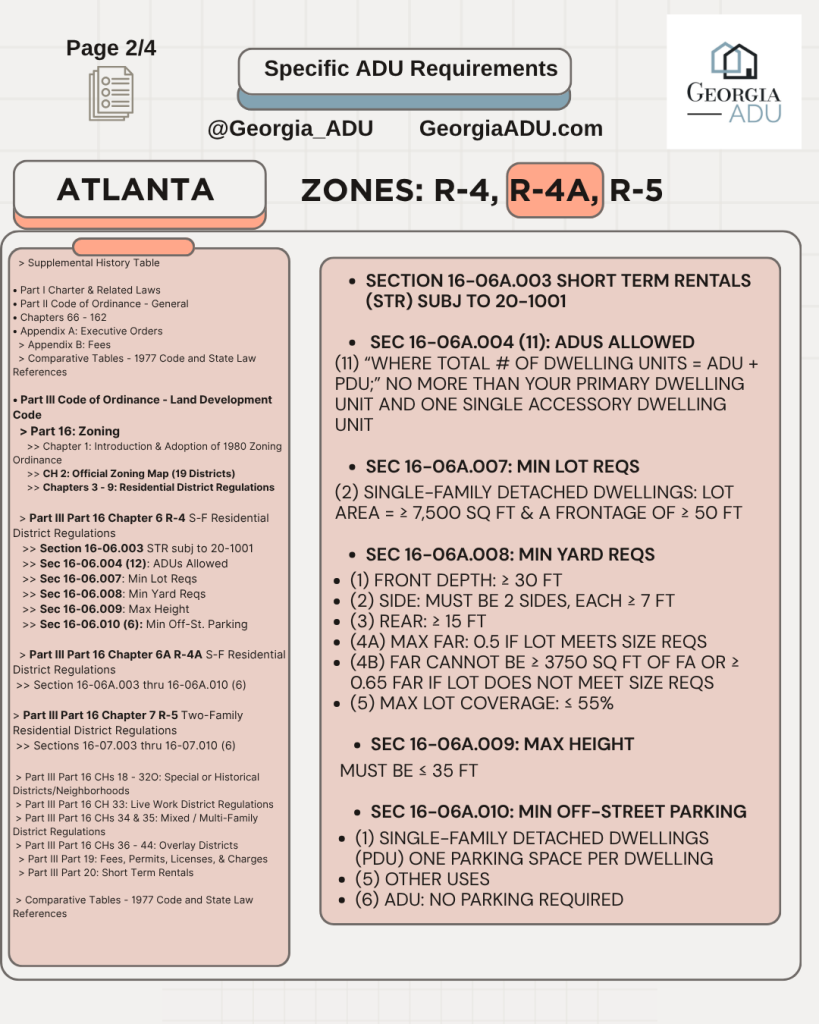
Where Atlanta City sits on the ADU fence is a speculative argument. From one stance, there are 19 Zoning Districts in Atlanta (per the adopted and withstanding Ordinance from 1980), and only 7 of those are categorized as Residential. Technically, when you dig into the code, you actually find 13 residential zones. All in all, only 3 of those 13 residential Atlanta zones are allowed to build ADUs. That means 77% of the residential zones in Atlanta prohibit ADUs. Some of this is due to proximity to MARTA, but the positive framing of this scenario is that the figure does not represent the equivalent land mass of properties. In other words, of the 3 zones in Atlanta permitted to build ADUs – R-4, R-4A, R-5 – it is estimated by some experts that they may account for upwards of 70% of Atlanta homeowners’ properties. Another angle of the argument is that the legislative code is organized in a structure that makes sense. You don’t have to chase your tail going from section to section to check qualifications. Simply hone in on your zone of question, and the Code outlines the requirements for your specific district. Another saving grace of Atlanta city code is that, when building an ADU, the city doesn’t obligate the homeowner to add or provide extra parking.
In the Atlanta City municipal code, the first noteworthy section is in Part I of the Charter and Related Laws. Chapter 7: Planning outlines the Historic Zones, Notice to Tax Assessors & Official Zone Changes, and Restriction on Rezoning of Annexed Land. The code continues on to Part II of the Code of Ordinance – General Ordinance, followed by Chapters 66-162, the Appendices, and finally reaches Part III.
It is within Part III of the Code of Ordinance – Land Development Code where we find the crucial Zoning and ADU regulations we’re looking for. Within Part III, the code breaks down with some redundantly named headers which can be slightly complex to follow, but that’s why we hope our visual outline in Graphic 1 helps to smooth out the wrinkles. Part III breaks down into more “Parts”, where you can find Part 16: Zoning, which is followed by Chapters 3 through 9 and encompasses the regulations for the residential zones. Chapters 9 – 17 are designated for the remaining non-residential zones. Chapters 18 – 320 describe special or historical districts and neighborhoods. Chapter 33 regulates Live Work Districts. Chapter 34 – 35 is designated for mixed use and multi-family districts. Chapter 36 – 44 concludes Part 16 with Overlay Districts. Other noteworthy portions of the code include Part 19 and Part 20 (of Part III) which discuss Fees, Permits, Licenses & Charges and Short Term Rentals, respectively.
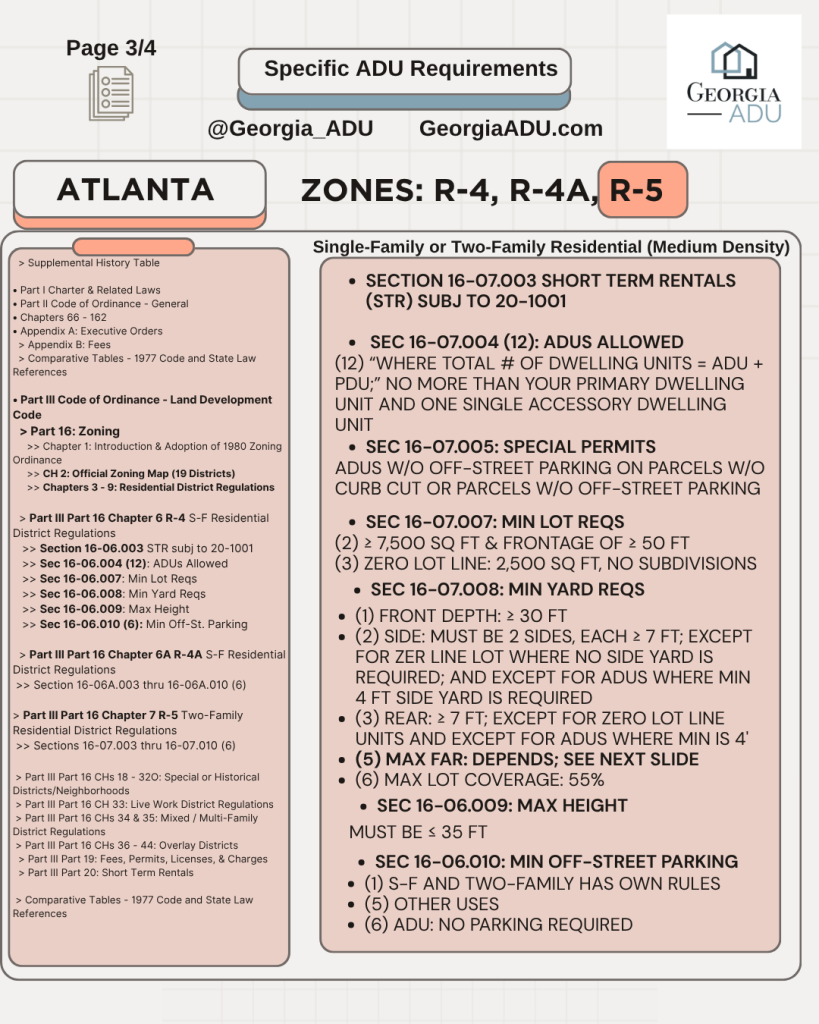
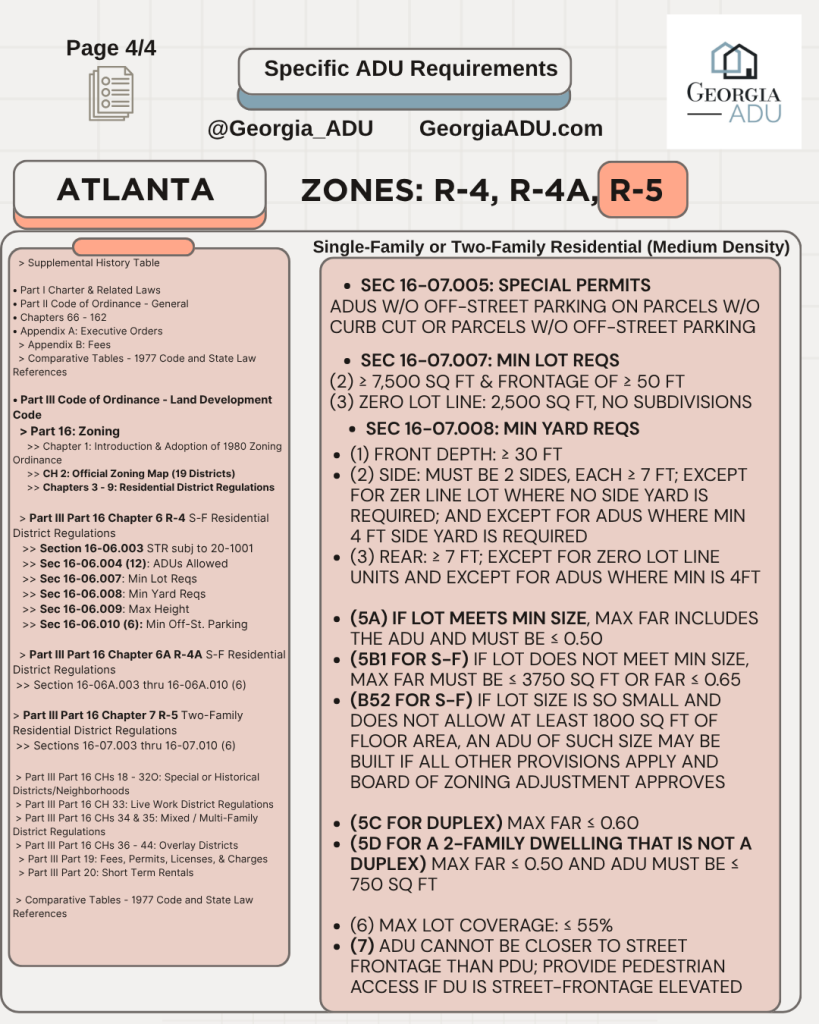
In order to jump to the sections discussing ADU permissibility, one should refer to the following sections:
- Part III Part 16 Chapter 6 Section 16-06.004 (12) – – Single-Family R-4
- Part III Part 16 Chapter 6A Section 16-06A.004 (11) – – Single-Family R-4A
- Part III Part 16 Chapter 7 Section 16-07.004 (12) – – Two-Family R-5 (medium density)
All three of these sections are broken down into similar outlines. R-5 has a few unique regulations due to it being medium density and inclusive of two-family homes (like duplexes). The distinguishing Atlanta outline is as follows:
- Section 16-__.003 establishes the permissibility of Short Term Rentals. For R-4, R-4A, and R-5, this is subject to regulation 20-1001.
- Section 16-__.004 establishes allowed Accessory Uses and Structures. This can differ between the zones, so please refer to each one, but ADUs are permitted as the last inclusion as (11) or (12), providing the number of total dwelling units on a parcel does not exceed two (PDU + ADU only). It’s interesting to note that where Atlanta specifies 12 lines of accessory uses, DeKalb micro-manages this by sorting the same information into 59 separate *sections* (Section 4.2.4 through 4.2.63).
- Section 16-__.007 establishes Minimum Lot Requirements.
- Section 16-__.008 establishes Minimum Yard Requirements.
- Section 16-__.009 establishes Maximum Height Requirements.
- Section 16-__.010 (6) establishes Minimum Parking Requirements (there are none for ADUs).
- Section 16-07.005 is unique to R-5 and establishes Special Permits.
- R-5 has special provisions with 16-07.007 and .008.
Which Municipality is the Least Restrictive and Most ADU-Friendly?
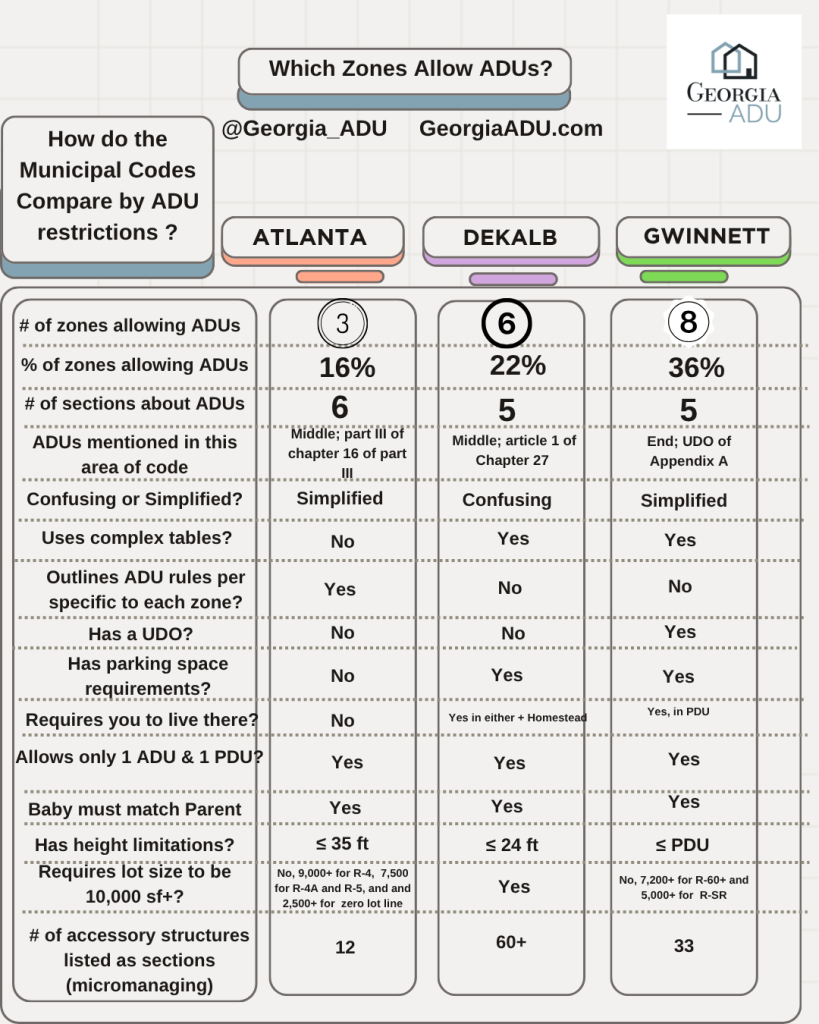
It’s worth noting that between the Dekalb, Gwinnett, and Atlanta Codes, the one PDU and only one ADU rule is shared. They don’t want more than two Dwelling Unit Structures on one parcel of land. The baby must match the parent rule is shared between DeKalb and Gwinnett. Atlanta doesn’t mind if there isn’t dedicated parking ON the property for the new ADU, but DeKalb and Gwinnett require extra parking (which usually increases the lot coverage – a bad thing) absolutely. Gwinnett and DeKalb also both mandate that the owner must live on the property, which means a real estate investor might face challenges – Gwinnett specifies the owner must live in the PDU, in fact!
While all three municipalities have varying degrees of setback expectations, height limitations, floor area ratio caps, and lot coverage maximums, they all basically chalk up to the same: it’s all based on ratios of space against the parcel’s size. One thing is clear, while Atlanta offers fewer allowable zones for building ADUs, Atlanta takes the cake with having looser restrictions than DeKalb or Gwinnett. Atlanta’s code is also written far less confusingly: Instead of having to check one section just to be referred back to a previous section, or chasing your tail to compare rules from various tables, Atlanta simplifies the navigation process by simply including ADU bullet points for each zone district. This way, all you have to do is locate your zone from GIS or tax parcel data, and scroll to ONE section – rather than a bounty of sections!
It is true, for all three municipalities, that the height restrictions are definitely a problem in the ADU community! Required setbacks, resistance to variances, tree protections, historic districts, and overlays all add to the restrictions imposed and complexity in determining rules in all three municipalities.
Both DeKalb and Gwinnett have a tight leash on homeowners regarding ADUs and allowable actions, despite offering many different residential zones to build ADUs in. For example, DeKalb is restrictive and requires the lot size to be 10,000 sq ft off the rip. While Atlanta seems to be more restrictive in terms of outright prohibition of ADUs in multiple zones (which is inherently a factor of zone size and location), for the zones it does permit ADUs in, (which is actually a huge proportion of properties), Atlanta is relatively inviting towards ADUs in those three zones!
Dekalb seems to be the most restrictive in terms of exact regulations. The DeKalb Code seemingly has an expertise in micro-managing. This relates to Gwinnett seemingly having the most straightforward code. While the implementation of the UDO can seem confusing at first, once you understand it’s just an Appendix at the end of their Code, the structure makes sense. Advertantly, Atlanta’s code is organized well, but the headers and numerical nomenclature are sometimes confusing and redundant.
So Which Zones Allow ADUs?
You finally made it to the end! Thank you so much for sticking with us and reading thus far. Here’s the treat below, a simple descriptor graphic, behold: