
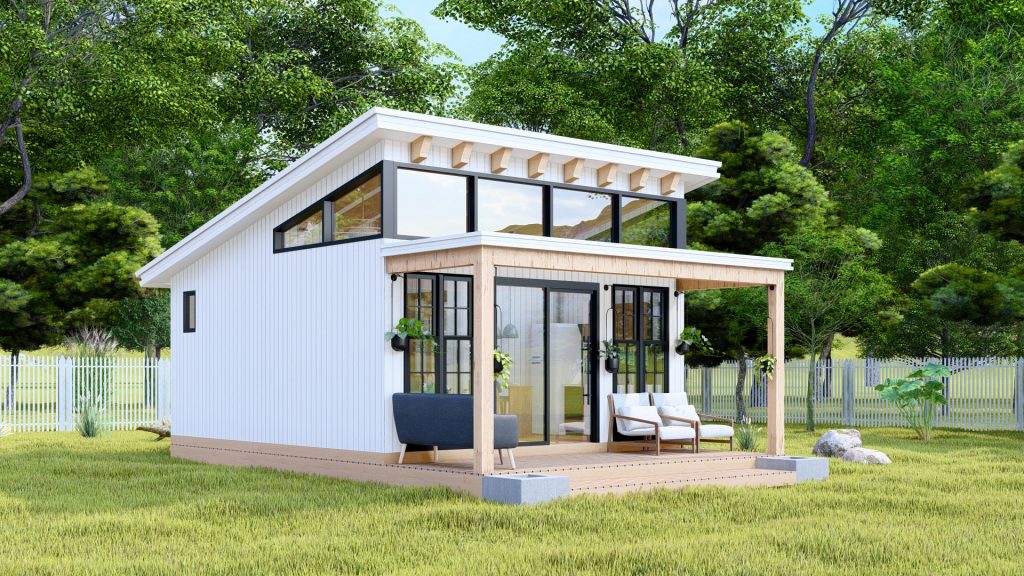
Accessory Dwelling Units (ADUs) are more than a trendy add-on — they’re emerging as strategic financial assets for homeowners and real estate investors in Atlanta’s evolving housing market. With rents already strong and mortgage rates stabilizing or trending modestly lower, ADUs can convert holding costs into income, build equity, and provide long-term value. Below is a clear, data-driven look at how a 750 sq ft ADU financed for $240,000 can perform over time.
It is important to note that Georgia ADU offers 8 customizable models which we can tailor to your unique property. The $240k price-point is an example scenario for illustrative purposes and there are lower cost (and higher cost) options we can help you navigate. Our models range from 400 sq ft to 1200 sq ft. For custom additions and conversions, the floorspace can be catered to your needs.
Accessory Dwelling Units (ADUs) continue to gain traction across Metro Atlanta as an affordable and flexible way to increase property value and generate passive income. As the city’s housing costs rise, homeowners are exploring ADUs not just for family use but as smart long-term financial investments.
In addition to traditional long-term rentals, many ADU owners tap into short-term rental (STR) demand — particularly from traveling professionals such as nurses, therapists, corporate employees, and contract consultants. Platforms like Airbnb and Vrbo have reported growth in work-related and extended stays, with hosts in many U.S. cities seeing strong month-to-month occupancy.
This provides an additional income avenue for ADU owners beyond traditional leases, especially in markets with steady tourism and professional travel demand. For example, according to AirDNA, in Atlanta the average monthly occupancy for short-term rentals in 2025 hovered above 65%, with many hosts reporting longer stays from touring professionals and contract workers.
This opens up opportunities for property owners and managers, but with an ADU – the bnb has the benefit of being in your own backyard. And think of events like the World Cup or the Peach Bowl and the income you can generate in such a short time frame!
Let’s walk through how taking advantage of today’s financing rates now translates into owning a valuable, income-producing asset for decades to come.
Table of Contents:
- Interest Rate Outlook
- Getting a HELOC for Your ADU Build
- Cash Flow Scenarios
- How is Investing in an ADU Better for Your Aging Parents?
- Atlanta Rent Market as a Strong Baseline for ADU Income
- Atlanta Rent Market and a Look at Rentable Unit Types
- Why Atlanta Makes This Strategy Work
- The Game Plan for Wealth by Building Your ADU
- Core Takeaways
- Source and Notes
1. Interest Rate Outlook
Mortgage rates in early 2026 remain high relative to the mid-2010s but have eased meaningfully from earlier peaks:
- Freddie Mac and other expert forecasts place the 30-year fixed mortgage rate near ~6–6.5% in 2026.
- Some models suggest rates could dip below 6% later in 2026 for the first time since September of 2022, improving refinancing potential.
2. Getting a HELOC for Your ADU Build
We consulted one of our trusted loan providers, the ADU Finance Guy, Charles Edington, to best outline advantageous strategies for our clients in this blog. We’re here to help you navigate through what you can expect to pay monthly and what you can expect to gain.
Charles says most people can conceptualize how they’ll pay for the ADU once it’s built and capable of generating passive cash flow, but how do you pay for it while it’s being built? He recommends a 10-year, interest-only Home Equity Line of Credit, or HELOC. This option functions as a credit card for your house (or ADU). It’s most advantageous to use this for construction because the structure of the payments omits paying any of the principal, allowed for up to ten years. The only bit you pay each month is the interest. Taking into consideration that it’s all about risk, the higher your credit score is, the lower this minimum interest payment will be.
It’s important to understand that a HELOC is only available if you currently possess equity in your home. If you bought your home within the last few years or refinanced recently, you may still be in the process of building equity. This depends if the value of your home is greater than what you owe. If you do possess equity, a HELOC could be a great option for you.
So how much can you get a HELOC for? Some can qualify for a HELOC of up to 95% of the value of your current property as it is, or you can borrow a line of credit up to 150% of what the property is anticipated to be worth after the improvements are complete (this is called a Renovation HELOC)! For example, if your home is worth $400,000 and you owe $250,000 on your mortgage, then your equity would equal $150,000. With some HELOC providers you can borrow up to 95% of that, or $142,500, in this example. Alternatively, if you qualify for 150% (equity plus future value of the ADU) you would get a loan for $225,000. This is how you, as a homeowner, can access your future equity. This is true leverage of your assets and debt for the purpose of creating more wealth.
If you do not currently possess equity in your home, don’t despair, a construction loan, unsecured personal loan or debt service coverage ratio (DSCR) loan may be a possibility. We can make an introduction to different funding sources depending on your situation. We also recommend consulting your tax expert and accountants regarding strategies to claim these expenses on your taxes for maximum benefits.There are some wonderful tax benefits and wealth transfer opportunities within ADU investments.
Once construction of your ADU is complete, and at the opportune moment when the interest rates drop (as they are expected to do!), we suggest refinancing your 10-year HELOC into a 20-year fixed-rate Home Equity Loan. This could be anywhere from a few months to a few years, but we are optimistic this will occur within the year of 2026. If you haven’t already begun paying towards the principal, you will at this point. Therefore, we recommend our clients anticipate financing an ADU as being a 10 to 30 year commitment, with an average of 20 years. Currently, the interest rates are realistically around 6.50% – 6.75% for a 20 year loan, and many expect those to fall to 6.0% or less as the year progresses.
Charles Edington is one of our trusted partners in navigating the best options for financing an ADU. To make scheduling easy, please feel free to choose a convenient time for a 30 minute introductory call using his calendar link: Schedule a Time Here. We promise you will gain a lot of important knowledge to help you in examining your possible ADU funding options. Let him know in the notes that Georgia ADU sent you!
Assuming you finance a $240,000 ADU with a 20-year loan at 6.5% interest, this would translate to roughly $1,789 per month in principal and interest payments. If the forecasts are accurate and that rate is closer to 6%, this would lower your payments to $1,719 per month (saving you $840 per year)
3. Cash Flow Scenarios
Rent vs Payment Over Time
Below are example scenarios assuming $2,100 – $2,250/month rent from a 750 sq ft 2 bed, 1 bath ADU and different financing structures. These illustrate how an ADU investment transitions from initial cost coverage to meaningful income as market conditions evolve.
Shorter loan terms may require early subsidy but can produce substantial long-term income once the ADU is debt-free. Longer amortization options prioritize immediate cash flow and affordability, while refinancing opportunities may further improve performance depending on future rate environments.
We built our Cash Flow table by using strong, but modestly conservative assumptions regarding rent rates. Here’s what that means:
Locked Assumptions and Definitions
- ADU Cost: $240,000
- Starting Rent: $2,250/month ○ (Very reasonable for quality 1–2BR ADUs in Decatur, East Atlanta, Kirkwood, Grant Park, etc.)
- Operating Costs: $400/month
- (Estimated operating costs including maintenance reserve, utilities contribution, and vacancy allowance.)
- Starting NOI (Net Operating Income Before Debt): $1,850/month
- NOI = Rent – Operating Costs
- NOI = $2,250 – 400 = $1850
- Rent Growth: 2% every 2 years, which is very conservative
- Cash Flow = NOI – Loan Payment
- This is described in the table below in 3d.
Rent & NOI Growth Schedule Table
The following table describes how Rent and NOI is expected to steadily increase over time. NOI equates to Rent – Operating Costs. Since Cash Flow equates to NOI – Loan Payment, this table is a preface to understanding the next table discussing cash flow by various interest rates.
| Year | Rent | NOI (After $400 Expenses) |
| Year 1 | $2,250 | $1,850 |
| Year 3 | $2,295 | $1,895 |
| Year 5 | $2,341 | $1,941 |
| Year 10 | $2,435 | $2,035 |
| Year 15 | $2,534 | $2,134 |
| Year 20 | $2,637 | $2,237 |
Cash Flow Table
The following table illustrates cash flow, which equates to NOI – Loan Payment. Please reference the table above to observe, on a very conservative scale, how rent and NOI will increase over time, subsequently increasing cash flow. Column A describes a high interest rate option which gets re-financed early (after Year 2 in this table) to a lower interest rate. It is important to note, we cannot predict when/if the interest rate will fall, but experts recommend taking advantage of this. Column B describes the average interest rate we are most commonly seeing for Home Equity Loans right now. Even if you begin with a HELOC, the goal is to refinance into a Home Equity Loan once rates fall. Column B is the median and most common path towards financing an ADU. Column C represents the lower end of the interest rate spectrum.
| Year | Option A: 20-yr at 7.0% → 6.0% | Option B: 20-yr at 6.5% | Option C: 20-yr at 6.0% |
| Monthly Payment | $1,861 → ~$1,690 | ~$1,791 | ~$1,720 |
| Year 1 | –$11/mo | $59/mo | $130/mo |
| Year 3 | $205/mo | $104/mo | $175/mo |
| Year 5 | $251/mo | $150/mo | $221/mo |
| Year 10 | $345/mo | $244/mo | $315/mo |
| Year 15 | $444/mo | $343/mo | $414/mo |
| Year 20 | $2,237/mo (loan paid off) | $2,237/mo (loan paid off) | $2,237/mo (loan paid off) |
Notes:
- This table implements conservative assumptions with a realistic but strong Atlanta rent baseline. This assumption compounds growth every two years, debt payments remain fixed and realistic, and NOI widens over time.
- All options turn positive before payoff
- Because rent grows while payments remain fixed, cash flow gradually improves.
- Option A shows the power of a modest refinance (or rate dip) to scale cash flow.
- Option A improves fastest after refinance
- The drop from 7% → 6% meaningfully lowers debt service.
- 20-yr at 7.0% = ~$1,861/mo loan payments
- Refi after Year 2 to 6.0% → new payment ≈ ~$1,690/mo
- We cannot predict when the rates will drop
- Option B is Conservative but steady.
- Nearly break-even at start, then grows steadily.
- This is the most realistic, current option.
- Option C is the cleanest immediate performer
- The lower the interest rate on a loan, the more immediate cash flow possible.
- Year 20 jumps for all options
- At payoff, debt disappears — so full NOI becomes cash flow.
- Options B and C immediately show positive cash flow.
- Quicker pay-offs with average to high interest rates favor:
- Long-term owners who don’t mind possible negative cash-flow early
- Investors seeking to build equity faster and convert to higher cash flow sooner
- High-income households
- Investors optimizing for post-debt income
- 20-year payment plans with low to average interest rates favor:
- Homeowners seeking to spread the cost out over time
- Homeowners who want immediate affordability and stability
- People seeking positive cash flow from Year 1
- 20-year payment plans which intend to refinance from a higher rate to a lower rate favor:
- Rate-sensitive borrowers
- Homeowners and investors seeking long-term rental strategy
- Homeowners and investors who can withstand risk-managed optimism (not speculative)
- People who are comfortable with investing with the current rate until rates soften
Why this matters: Even if early years show small cash shortfalls, rent growth over time and rate improvements can turn the ADU into a strong income producer while building equity.
4. How is Investing in an ADU more Attainable for Your Aging Parents than Trying to Meet the Rising Costs of Assisted Living and Senior Living Homes?
For many families, keeping aging parents close can be both emotionally rewarding and significantly more affordable than traditional assisted living or senior living communities. In the U.S., the median cost of assisted living nationally is over $6,300 per month — more than $75,000 per year — and can vary by state and level of care required. In metro-Atlanta, as of early 2026, Genworth and its partner CareScout report that the monthly median cost for an assisted living facility in the Atlanta metro area is approximately $4,620, with high-demand areas often seeing starting rates closer to $6,500/month. Those figures also escalate quickly as care needs increase.
These expenses typically do not include additional services such as personal care, specialized memory care, or medical oversight, and Medicare generally does not cover room and board in assisted living settings. In contrast, investing in an ADU — even at a one-time cost of around $240,000 — allows seniors to remain close to family in a private, accessible space designed for aging in place. Over a decade or longer, the total cost of home-based care (including an ADU and modest support services) can be significantly lower than the cumulative cost of institutional care, while also preserving independence and family cohesion. In addition to creating sustainable peace of mind within your family dynamic, by increasing the housing density of your property, you are inherently elevating your property value.
5. Atlanta Rent Market: Strong Baseline for ADU Income
Atlanta’s rental market remains robust in late 2025 and into 2026:
| Data Source | Average Rent |
| Redfin Rental Market Report (2025) | ~$1,930/month on average in Atlanta |
| Zillow Rental Trends (Jan 2026) | ~$2,045/month average rent |
| RentCafe Neighborhood Data (2026) | Many Atlanta neighborhoods rental range: ~$1,900–$2,500+ |
Interpretation:
A well-positioned 750 sq ft detached ADU with one or two bedrooms can reasonably command $2,000–$2,300/month in many Atlanta submarkets, providing a strong rental baseline to support financing.
6. Atlanta Rent Market: A Closer Look at Rentable Unit Types
Atlanta’s rental market remains resilient heading into 2026, with distinct demand and pricing dynamics for one- and two-bedroom units—both of which are directly relevant when evaluating the income potential of a 750 sq ft ADU.
Average Atlanta Rent by Unit Type
| Unit Type | Average Monthly Rent | Source |
| 1-Bedroom Apartment | ~$1,650–$1,850 | Zillow, RentCafe |
| 2-Bedroom Apartment | ~$2,100–$2,450 | Zillow, Redfin |
Sources:
- Zillow Rental Market Trends – Atlanta (2025–2026)
- RentCafe Atlanta Rent Report (2026)
- Redfin Rental Market Data – Atlanta
Why This Matters for ADUs
Most 750 sq ft ADUs fall between a large one-bedroom and a compact two-bedroom in functionality. ADUs also include storage space, living room, kitchen, bathroom(s), and porch(es). As a result:
- ADUs often price above average one-bedroom rents
- And remain competitive with entry-level two-bedroom units, particularly when detached, newly constructed, or located in high-demand neighborhoods
In many Metro Atlanta neighborhoods—such as East Atlanta, Decatur, Old Fourth Ward, Grant Park, Kirkwood, and portions of Buckhead—well-designed ADUs are realistically achieving rents in the $2,000–$2,300/month range, depending on finishes, privacy, parking, and proximity to transit or job centers.
Market Context for 2026
While rent growth has moderated from the post-pandemic surge, Atlanta continues to experience:
- Sustained renter demand driven by population and job growth
- Limited supply of small, high-quality rental units
- Increasing preference for flexible, smaller-footprint housing options
This combination supports the long-term viability of ADUs as income-producing assets, especially when evaluated against one- and two-bedroom market benchmarks rather than averages alone.
7. Why Atlanta Makes This Strategy Work
Strong & Stable Rents
With average rents above $2,000/month in 2026, secondary units in desirable neighborhoods can command attractive income.
Growing Demand
Metro Atlanta continues to attract renters due to job growth, transportation access, and lifestyle amenities — supporting ADU rental demand higher than many national averages.
Construction Feasibility
Building a 750 sq ft ADU for $240,000 is within typical costs, making it a scalable addition for many homeowners. When paired with a rent stream and strategic financing, it becomes an asset that pays toward its own cost.
8. The Game Plan for Wealth by Building Your ADU
- Finance on a 20-year structure at ~6.0% – 6.5% (realistic refinanced scenario).
- Rent the unit at ~$2,100/month (supported by 2026 market averages).
- Achieve positive monthly cash flow in Year 1 and grow stronger over time.
- Build equity while creating a net income stream.
This scenario demonstrates how ADUs can deliver both cash flow and long-term return on investment for homeowners and investors alike.
9. Core Takeaways
- Building an ADU is an investment that allows you to put outside money (HELOC) in, in order to gain a monthly positive, cash flow return. While simultaneously building equity, property value, and a multi-generational asset, you can also generate monthly, passive income. Even if initial payments on shorter terms temporarily exceed rent, refinancing and rent growth help tilt the balance toward positive cash flow.
- With average rents above $2,000/month, a 750 sq ft ADU can cover or exceed long-term financing costs.
- Atlanta’s rental demand and neighborhood rent premiums support strong returns relative to many U.S. metros.
- Real estate investors and homeowners alike benefit from ADUs that generate income while building property value and home equity.
- When you expand your property’s housing density, you have the option to rent the primary residence or the accessory residence. In either scenario, you could offer long term rentals or short term rentals. There are pros and cons to each, and many Atlanta-ians are seeing great success with STRs!
- Georgia ADU offers 8 customizable models. While our base price is inclusive of certain services, the option to build a smaller ADU for a less expensive investment does exist. Georgia ADU builds ADUs between 400 square feet to 1200 square feet, and we can customize your floor plan and finishes to cater to your family’s and your property’s unique needs.
10. Sources and Notes
- Atlanta rental data — Redfin & Zillow (2025–2026)
- Neighborhood rent breakdown — RentCafe (2026)
- Mortgage rate forecasts for 2026 — Bankrate & Mortgage Forecasts averaging ~6–6.2%
- Atlanta average rent ~$1,774/month (2025 data) RentCafe+1
- One-bedroom median ~$1,600/month in Atlanta (Nov 2025) FOX 5 Atlanta
- ADU cost average ~$181,000, cost/sq ft ~$162-$682 (national data) Building an ADU
- HELOC / home-equity loan rates expected to decline into 2026 Bankrate+1
- Median rent in Atlanta (Nov 2025) – Zumper.
- Interest-rate forecasts – Goldman Sachs / Mortgage industry analyses.
- Assisted Living Care – CareScout
- Rental averages in Atlanta – RentCafe.
- Freddie Mac Economic & Housing Research, “U.S. Economic Outlook” (Oct 2025)
- Zillow Home Value Index, “ADU Impact on Property Values” (2025)
- Zillow & RentCafe, “Atlanta Rental Market Report” (Nov 2025)
- Bankrate, “Fed Rate Cut Forecasts for 2026” (Nov 2025)
- Median U.S. assisted living cost in 2026: SeniorLiving.org — $6,313/month (>$75,000/year).
- Georgia assisted living costs: NCOA reports typical U.S. averages with state variation.
- Medicare does not cover assisted living room/board: Investopedia (Medicare Coverage).
- ADU cost vs long-term assisted living: SeniorSite compares ADU build cost to long-term care.
Disclaimer: This article is provided for general educational purposes only and does not constitute financial, legal, or tax advice. Financing terms, qualification requirements, rental performance, and market conditions vary by individual circumstance. Please consult with a licensed lender, financial advisor, accountant, realtor or legal professional to evaluate what may apply to your specific situation.