
Stand in your backyard for a minute and look back at the house. Is there a flat patch of grass out there, or does the yard drop off toward the fence? Is there a big oak in the middle of it? Those two questions settle more of the attached ADU versus detached debate than almost anything you’ll read online. Homeowners usually arrive with a strong preference already. Then they see the lot through a builder’s eyes, and about half of them change their minds.
Both options give you a separate, legal living space with its own kitchen, bathroom and entrance. The difference is whether that space shares a wall with your house or sits on its own somewhere else on the property. That sounds like a small distinction. It isn’t, and it affects cost, privacy, permitting and how you’ll use the space ten years from now.
What counts as an attached ADU
An attached ADU is a self-contained unit connected to the main house. It might be a new addition off the back or side, a converted basement with its own exterior door, or a finished space over an attached garage. Many families call it an in law suite, and the term fits: the unit is close enough to check on someone, but separate enough that nobody’s tripping over anybody else at breakfast.
What makes it an ADU rather than just a bigger house is independence. A true attached ADU has its own entrance, its own kitchen and its own bathroom, and it can function as a separate dwelling. A bedroom and bath added off the hallway is an addition. It may be lovely, but it’s a different thing on paper.
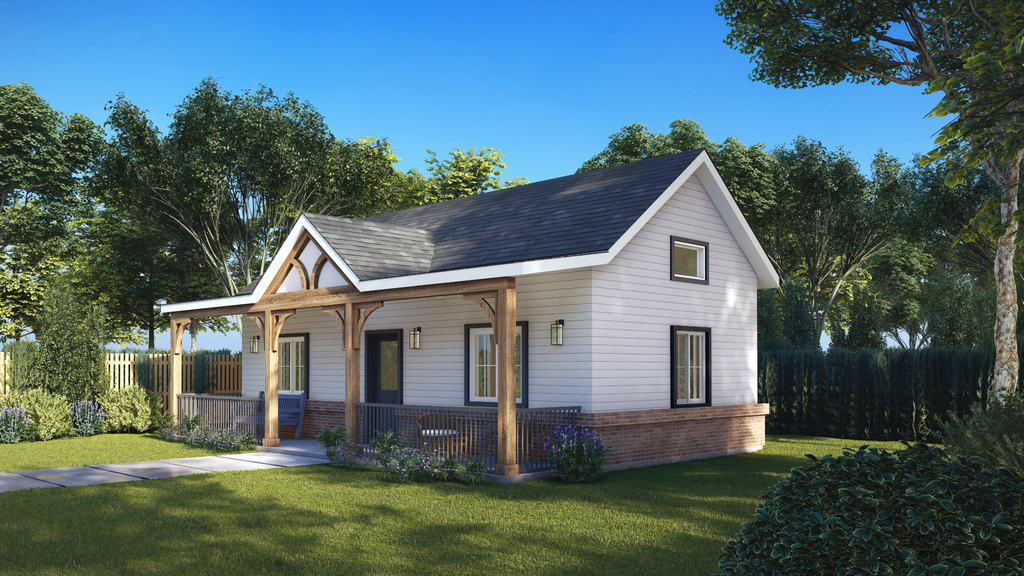
A detached ADU, by contrast, is a freestanding building. Backyard cottage, carriage house, garage apartment over a detached garage. It has its own foundation, its own roof and its own utility runs back to the house or the street.
The cost difference is real, but smaller than people expect
Here’s the number most homeowners want first. In our cost guide, an attached ADU of 400 to 750 square feet typically lands between $140,000 and $220,000 all in. A detached one-bedroom of 500 to 600 square feet runs about $175,000 to $220,000. You’ll notice those ranges overlap quite a bit. The full breakdown is in our Atlanta ADU cost guide, but here’s the short version of why.
An attached ADU saves money in a few places. It shares at least one wall with the house, so there’s less exterior framing and siding. Utility runs are short, sometimes just a few feet, instead of a long trench across the yard. And depending on the design, the unit can sometimes tie into the existing roofline.
But it also creates costs a detached unit avoids. You’re cutting into a house that people live in. The new foundation has to meet the old one properly, the roofs have to tie together without leaking, and the existing electrical panel or water heater may not have room for a second household. In older intown homes, opening a wall can turn up surprises, like undersized framing, old wiring or a crawlspace that needs work. Those fixes go into the attached ADU budget, not the detached one.
So which is cheaper? Honestly, it depends on the house more than the type. An attached ADU on a 1990s home with a modern panel and a flat side yard can come in well under a detached cottage. One on a 1920s bungalow with knob-and-tube wiring might not.
How your lot makes the decision for you
We said the backyard settles a lot of this. Here’s what we look at.
Slope and drainage
Atlanta’s rolling terrain is beautiful and expensive to build on. If the backyard drops away from the house, a detached unit may need retaining walls, a stepped foundation or a grinder pump to push wastewater uphill to the sewer. An attached ADU built off the side of the house often sits at the same grade as the main structure and can use the house’s existing sewer line. On a steep lot, that alone can tip the math.
Trees
Atlanta takes its tree canopy seriously. Removing a large hardwood can trigger an arborist review and recompense fees under the city’s tree ordinance. If the only flat spot for a cottage is right where a big oak stands, building onto the house might be the simpler path.
Lot size and setbacks
Narrow intown lots don’t always have room for a freestanding building that meets rear and side setbacks. An attached ADU uses space you already have next to the house. On the other hand, a deep lot with a wide backyard gives a detached unit room to breathe, and that’s often the better use of it.
Access
Can a concrete truck get to the back of your lot? Can a dumpster sit in the driveway for four months? Tight access drives up detached costs because materials get carried by hand. An attached ADU near the street side of the house sidesteps much of that.
Privacy, family and the long game
Cost and lot conditions are the practical side. The personal side matters just as much, and it’s where we see the most second-guessing.
If you’re building for an aging parent, an attached ADU has real advantages. You can hear if something’s wrong. Getting to them in bad weather doesn’t involve a walk across a wet yard. Some families even add an interior door between the house and the attached ADU that can be locked from both sides, so the unit works as part of the house now and as a fully separate rental later. AARP’s Livable Communities program has written a lot about ADUs as a way for older adults to stay close to family while keeping their independence, and that’s exactly the situation where attached units tend to shine.
If the plan is rental income, the picture flips, and an attached ADU starts to look less appealing. Tenants generally pay more for a unit that feels like its own little house, with no shared walls and a yard of its own. And you’ll probably appreciate the separation too. A detached cottage behind the house gives everyone more breathing room, especially if the tenant works odd hours.
Then there’s resale. A well-built detached cottage reads as a clear second dwelling to buyers. An attached ADU can read either way: as a flexible in-law setup or as part of a bigger house. Neither is wrong. It just depends on who your future buyer is likely to be.
Zoning and permits in Atlanta
This is the part where we have to be careful, because the rules keep evolving and the two types aren’t always treated the same way. Inside the City of Atlanta, the detached unit is the standard case: a detached ADU is allowed by right on a single-family lot in the R-4, R-4A and R-5 districts, subject to size, height and setback limits that differ between districts. An attached unit, meaning a second dwelling inside or added onto the main house, can be handled differently depending on your district, and the city has discussed broadening those rules more than once. Don’t assume the two paths are interchangeable on paper.
Before you fall in love with a design, check your parcel’s zoning with the Atlanta Department of City Planning or have your builder do it. Outside the city limits, Cobb, DeKalb, Gwinnett and Fulton each have their own codes, and some treat an attached ADU quite differently from a detached one. We cover the city rules in more depth in our guide to ADUs in Atlanta.
One more thing worth knowing: the federal government has been paying attention too. HUD’s Office of Policy Development and Research has published research on ADUs as a way to add housing in existing neighborhoods, and that’s part of why local rules across the country have been moving in a friendlier direction.
A quick way to think about it
If you want a rough gut check before talking to anyone, here it is.
- Lean toward an attached ADU if your lot is narrow or steep, if you’re housing a parent who may need help, if a big tree sits in the only good backyard spot, or if your house’s systems are relatively modern.
- Lean detached if you have a deep, flat yard, if the main goal is rental income, if privacy matters more than proximity, or if your home is old enough that cutting into it worries you.
Plenty of lots fall in the middle. That’s normal. When they do, we usually sketch both options on the actual site plan and price them side by side, because the right answer tends to show up once real numbers are on the table.
It also helps to work with an ADU company that does both attached and detached units. A company that only does one type has a reason to steer you toward it. We’d rather tell you a cottage makes more sense on your lot than talk you into an addition that fights the house.
Final thoughts
There’s no universally better choice here. An attached ADU makes the most sense when the house and the lot cooperate and when closeness is the point. A detached unit makes the most sense when you have the yard for it and want real separation. The mistake we see most often isn’t picking the wrong type. It’s picking one before anyone has walked the property and looked at the slope, the trees, the sewer line and the electrical panel. So start there. A free lot assessment is the fastest way to find out which option your property is quietly voting for, and you can schedule yours here.